These page will contain the conclusions and answers to the properties of materials lab session. In this lab session we tested some materials with ionic, covalent and metallic bonds to test their properties and complete this table below.
This entry will also contain the questions about the properties that we tested in the lab that we were given in class.
Properties of materials table completed in the lab:


- Why do ionic compounds dissolve in water?
An ionic compound is a chemical bond in which atoms interchange their valencies, these means that the atoms are very close together meaning that the bond is very strong. Water attracts the positive and negatives ions, breaking the bond between them and dissolving them.
- Why do covalent compounds dissolve in acetone (organic solvent)?
Covalent compounds are soluble in organic solvents (like acetone) because of polarity.
Generally, covalent compounds are non polar, as well as organic compounds.
Two substances are soluble if they have the same polarity.

- Why do metal conduct electricity?
Metals conduct electricity so well because they are what we call a conductor. A conductor is a substances which has different characteristics, metals for example have a high range of free electrons that move freely though the substance, as this electrons are not being held to the atom they can move freely, this is why they conduct electricity. The best metallic conductors are copper (Cu), silver (Ag) and gold (Au).

- Why do covalent compounds do NOT conduct electricity?
In a covalent bond, the electrons are "shared" to form a bond between nonmetals.
This means that the electrons are fixed in a certain position and are not able to move around to carry the electrons to conduct electricity.
- Why do ionic compounds have such high boiling points?
As said before, ionic compounds are chemical bonds where the atoms interchange their valencies, as we can see on this image to understand better the explanation.
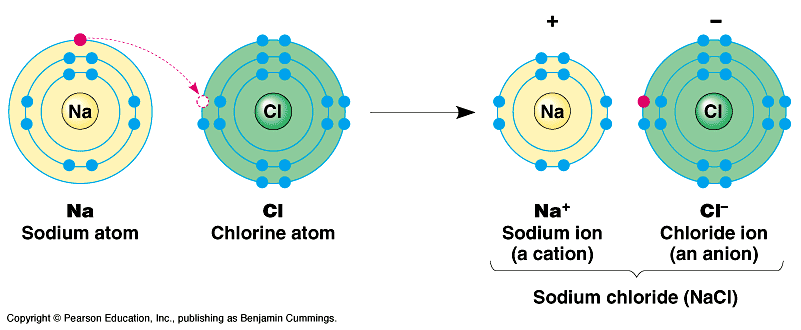
As they are forced to be very close together their bond is very strong, so it will require more energy for the bond to be broken. When we increase the temperature of a certain substance, we increase the temperature of a certain substance, we create kinetic energy that makes the atoms move faster, breaking the bond transforming into a gas. So as ionic bonds are very strong, we'll need a higher temperature to create more energy to break the bond.
- Why do metals have such high boiling points?
Metals usually have high melting points and boiling points because of the characteristics of metallic bonds(two or more metals).
This type of bond share the electrons. They tend to have high electric conductivity, malleability and ductility.
_______________________________________________________________________________________
BIBLIOGRAFY
Eweb.furman.edu (2013). Darwin1. [online] Retrieved from: http://eweb.furman.edu/~wworthen/bio111/102atoms.htm [Accessed: 5 Nov 2013].
Studios, A. (2013). Physics4Kids.com: Electricity & Magnetism: Conductors. [online] Retrieved from: http://www.physics4kids.com/files/elec_conduct.html [Accessed: 5 Nov 2013].
Shukla, B. (2013). What are the characteristics of covalent compounds ?. [online] Retrieved from: http://www.preservearticles.com/201101012187/the-characteristics-of-covalent-compounds.html [Accessed: 5 Nov 2013].
Shukla, B. (2013). What are the characteristics of covalent compounds ?. [online] Retrieved from: http://www.preservearticles.com/201101012187/the-characteristics-of-covalent-compounds.html [Accessed: 5 Nov 2013].

No comments:
Post a Comment